Vascular Access for Chemotherapy
Image-guided placement of central lines and ports for patients undergoing chemotherapy or other long-term intravenous treatment. Performed by a consultant interventional radiologist.
Is this you?
The information on this page may be relevant if any of the following describe your situation:
You need ongoing chemotherapy or repeated IV infusions and a reliable access point would help.
You require long-term intravenous antibiotic treatment.
You have difficult peripheral veins, and previous cannulas have been hard to insert or have failed.
Your clinical team has recommended a PICC line, a Hickman line, or a tunnelled central venous catheter.
What is vascular access
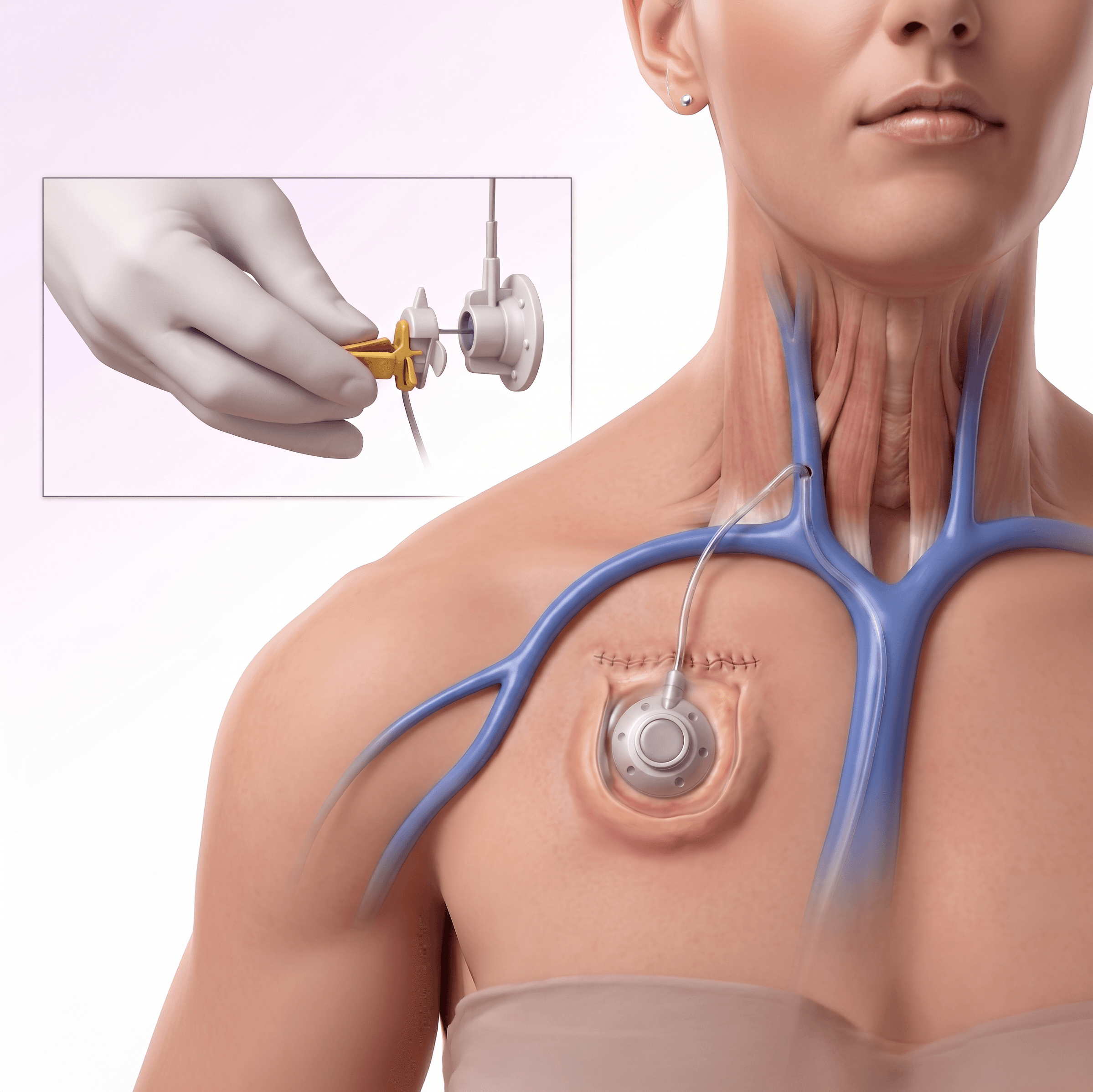
Vascular access procedures place a fine catheter into a large vein under image guidance, so that medication, fluids, blood products, or chemotherapy can be given reliably over weeks or months. Common types include the PICC (peripherally inserted central catheter) and the tunnelled central venous catheter such as a Hickman line.
Who may be suitable
Vascular access is most commonly arranged at the request of the team caring for the patient — oncology, infectious diseases, nutrition support, or the GP — when a course of treatment is planned and ordinary cannulas are not appropriate. Each request is reviewed individually to ensure the right type of line is placed.
What the procedure involves
The procedure is performed under ultrasound and X-ray guidance, with local anaesthetic. A fine catheter is positioned with its tip in a large central vein, and the line is secured to the skin. The procedure is usually a day-case.
Recovery and follow-up
Most patients are discharged on the same day. Any concerns about the line should be communicated to the referring team promptly.
Risks and what we discuss at consultation
Vascular access procedures carry risks, including bruising at the access site, infection, blockage of the line, and rare but more serious complications such as bleeding or lung-related issues. The risks, benefits, and alternatives relevant to your situation are explained in full at consultation.
How to be referred
Vascular access is arranged primarily through the Refer a patient page, or by email to info@pinholeclinic.co.uk. Patients can also enquire directly and we will liaise with the relevant clinical team.

Dr. Marawan Elfarargy
The information on this page is provided for general educational purposes. It is not personalised medical advice and should not be used to make decisions about your treatment.
Suitability for any minimally invasive procedure depends on individual clinical assessment, including diagnosis, imaging, and a discussion of the full range of treatment options with the appropriate clinical team. All procedures carry risks. Individual outcomes vary depending on diagnosis, anatomy, and overall health.
The risks, benefits, and alternatives relevant to your situation will be discussed with you at consultation, and you will have the opportunity to ask questions before any decision about treatment.
